SoulRiddle
HomeExploreAgentsRankingLearnDocs
Log in

Choose how to continue

No signup needed to explore.Other options
Menu
HomeExploreAgentsRankingLearnDocs

Soulriddle - AI prompt community

DisclaimerPrivacyTermsCopyright

Learn

Divination & AI FAQ

AI Prompts & Tools
01What Are AI Divination Prompts?06How Do You Choose the Right AI Prompt for Your Question?07What Makes an AI Divination Prompt Clear, Specific, and Useful?08Which Personal Details Are Helpful to Include in an AI Prompt?16How Do You Customize a Community AI Prompt for Your Own Situation?17How Do You Know Whether a Community AI Prompt Is Worth Trying?22What Are AI Agents, and How Can They Support a Daily Reflection Routine?
Western Divination
02How to Use Tarot Prompts with ChatGPT09What Is a Tarot Spread, and Which One Should Beginners Try?10What Should You Include in an Astrology Birth Chart Prompt?11How Do Transits Differ From a Natal Chart Reading?15Can AI Help You Explore Numerology Without Making Absolute Claims?18Can AI Interpret a Single Tarot Card?19How Can AI Help You Understand the Major and Minor Arcana?20What Is Synastry, and How Can AI Help You Explore It?
Eastern Traditions
03I Ching vs. Tarot: Which Should You Choose?04What Is BaZi?12How Do You Ask a Clear Question for an I Ching Reading?13What Do Changing Lines Mean in the I Ching?14How Does BaZi Differ From Western Astrology?
Reflection, Safety & Practice
05How to Use AI for Self-Reflection Responsibly21How Can AI Help You Reflect on a Dream Without Overinterpreting It?23How Do You Turn an AI Reading into Practical Next Steps?24What Are the Limits of AI in Tarot, Astrology, and Divination?25How Can You Protect Your Privacy When Sharing Personal Details with AI?
Browse all 25 guides
01What Are AI Divination Prompts?02How to Use Tarot Prompts with ChatGPT03I Ching vs. Tarot: Which Should You Choose?04What Is BaZi?05How to Use AI for Self-Reflection Responsibly06How Do You Choose the Right AI Prompt for Your Question?07What Makes an AI Divination Prompt Clear, Specific, and Useful?08Which Personal Details Are Helpful to Include in an AI Prompt?09What Is a Tarot Spread, and Which One Should Beginners Try?10What Should You Include in an Astrology Birth Chart Prompt?11How Do Transits Differ From a Natal Chart Reading?12How Do You Ask a Clear Question for an I Ching Reading?13What Do Changing Lines Mean in the I Ching?14How Does BaZi Differ From Western Astrology?15Can AI Help You Explore Numerology Without Making Absolute Claims?16How Do You Customize a Community AI Prompt for Your Own Situation?17How Do You Know Whether a Community AI Prompt Is Worth Trying?18Can AI Interpret a Single Tarot Card?19How Can AI Help You Understand the Major and Minor Arcana?20What Is Synastry, and How Can AI Help You Explore It?21How Can AI Help You Reflect on a Dream Without Overinterpreting It?22What Are AI Agents, and How Can They Support a Daily Reflection Routine?23How Do You Turn an AI Reading into Practical Next Steps?24What Are the Limits of AI in Tarot, Astrology, and Divination?25How Can You Protect Your Privacy When Sharing Personal Details with AI?
25 practical guides

Clear, grounded introductions for using divination and AI as tools for reflection.

Soulriddle FAQ · 08 of 25

Which Personal Details Are Helpful to Include in an AI Prompt?

A practical, beginner-friendly answer for using AI and divination as a tool for reflection.

Short answer

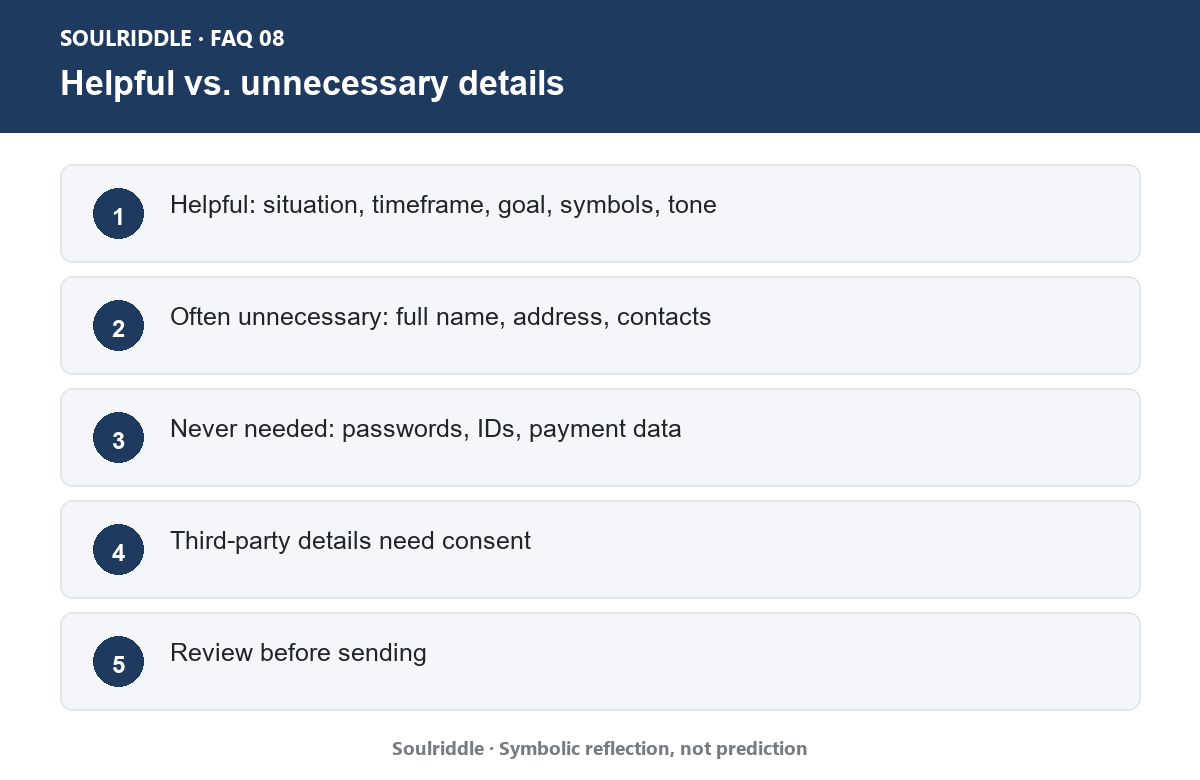
Include only details that materially affect the answer, such as your general situation, timeframe, goals, chosen symbols, and preferred tone. You usually do not need your full name, address, contact details, passwords, financial information, medical records, or identifiable details about another person. A good prompt can be personal without being identifying. The goal is to give enough context for a useful response while keeping unnecessary risk out of the conversation.

Why this matters

Sharing less protects you and the people you might describe. AI services may store, process, or use conversations in ways that are not always transparent, so the safest default is to minimize sensitive input. Most reflection and divination prompts do not require real names or precise locations. General categories such as age range, broad region, relationship type, and timeframe are usually enough to make the answer relevant.

How to approach it

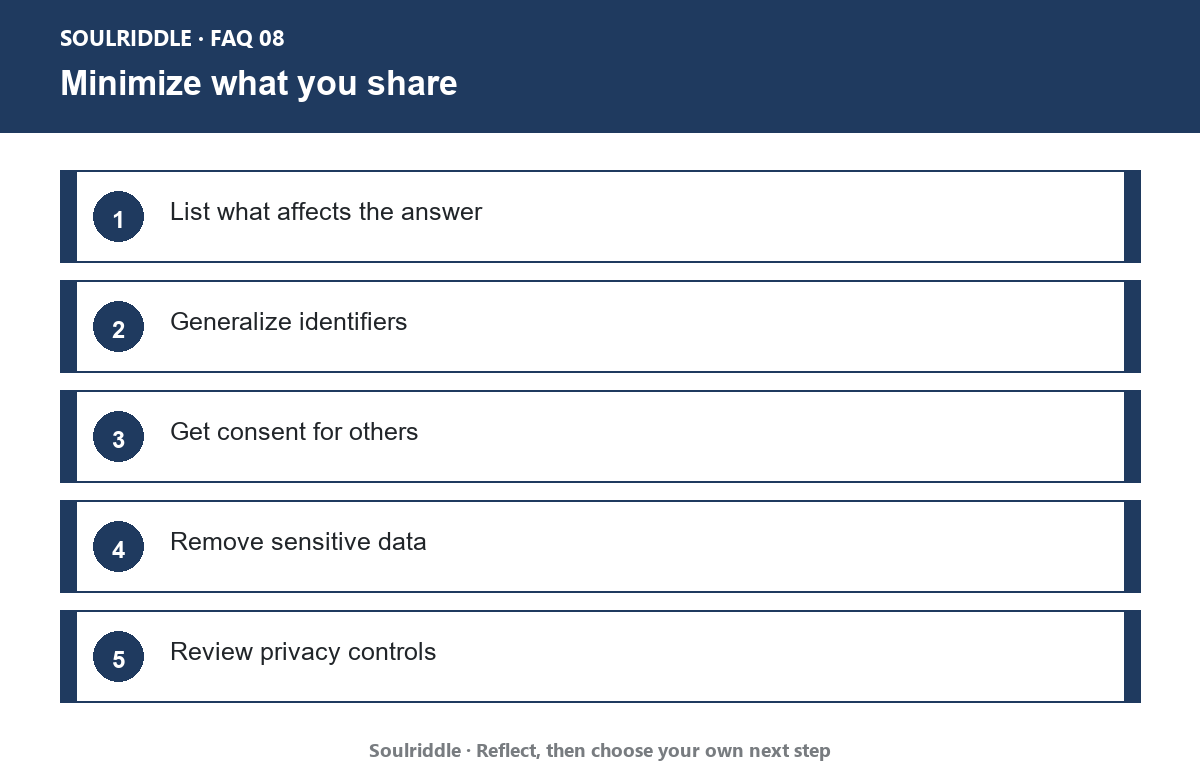
Before writing, list the facts that could change the interpretation: the situation, the decision, the symbols, and the timeframe. Then replace specific identifiers with general equivalents. For example, say a mid-size city in the eastern United States instead of a full address, or a colleague instead of a person's name. If you are asking about another person, get their permission first or describe the dynamic without identifying them. Review the prompt once for contact details, account numbers, passwords, and medical or legal specifics.
Which Personal Details Are Helpful to Include in an AI Prompt?

Helpful vs. unnecessary details

What to avoid

Do not include passwords, government IDs, bank or card details, precise addresses, full names, contact information, or medical records. Avoid sharing identifiable details about a third party without consent. Do not assume that deleting a chat removes all stored data, and do not enter sensitive material into a tool whose privacy policy you have not reviewed.
Which Personal Details Are Helpful to Include in an AI Prompt?

Minimize what you share

A prompt you can adapt

I am reflecting on [general situation] over the next [timeframe]. My main goal is [goal]. The symbols I am using are [symbols], and I would like a [tone] response. Please do not ask for my name, address, financial details, or medical information.

Key takeaway

Key takeaway: Use the minimum useful context. General situation, timeframe, goal, symbols, and tone are usually enough; sensitive identifiers are not.

Source

Source page: Information privacy - Wikipedia

Open source page: view the linked page

Open source ↗
Which Personal Details Are Helpful to Include in an AI Prompt?

Source page screenshot: Information privacy - Wikipedia

Explore prompts

Put the guide into practice

Find a community prompt, then adapt it to the context you already have.

Browse all prompts →

In this answer

1. Short answer2. Why this matters3. How to approach it4. What to avoid5. A prompt you can adapt6. Key takeaway7. Source

Continue learning

What Should You Include in an Astrology Birth Chart Prompt?How Do Transits Differ From a Natal Chart Reading?How Do You Ask a Clear Question for an I Ching Reading?