Soulriddle FAQ · 07 of 25
What Makes an AI Divination Prompt Clear, Specific, and Useful?
A practical, beginner-friendly answer for using AI and divination as a tool for reflection.
Short answer
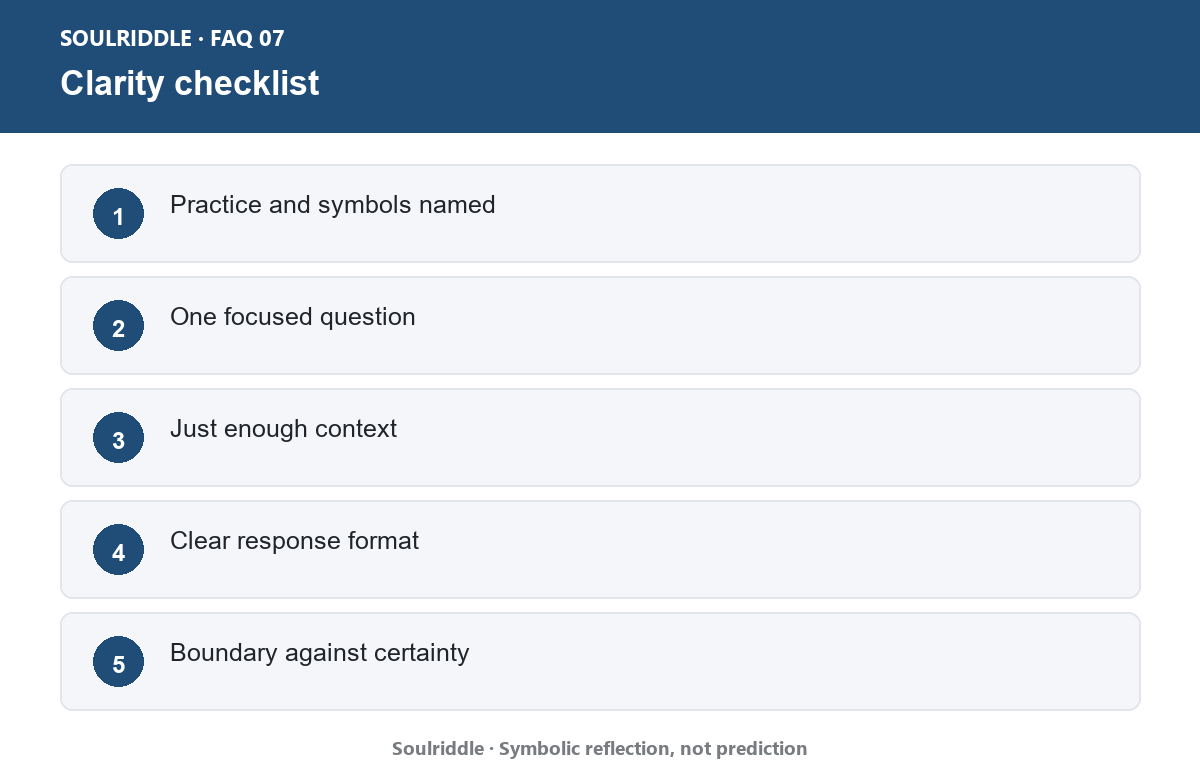
A strong divination prompt names the practice or symbol, asks one focused question, gives relevant context, and requests a clear response format. It also sets a boundary, such as asking for reflective possibilities rather than certainty. Specific instructions make the answer easier to evaluate and adapt because you can see whether the model followed the structure you requested. A clear prompt does not need to be long; it needs to remove avoidable guesswork.
Why this matters
Divination language is full of symbols and open-ended meanings, so a model can easily drift into broad statements that sound relevant but are not tied to your question. Being specific about the card, hexagram, chart placement, or dream image reduces that drift. The boundary against certainty also keeps the output in the symbolic-reflection frame rather than turning it into a false prediction.
How to approach it
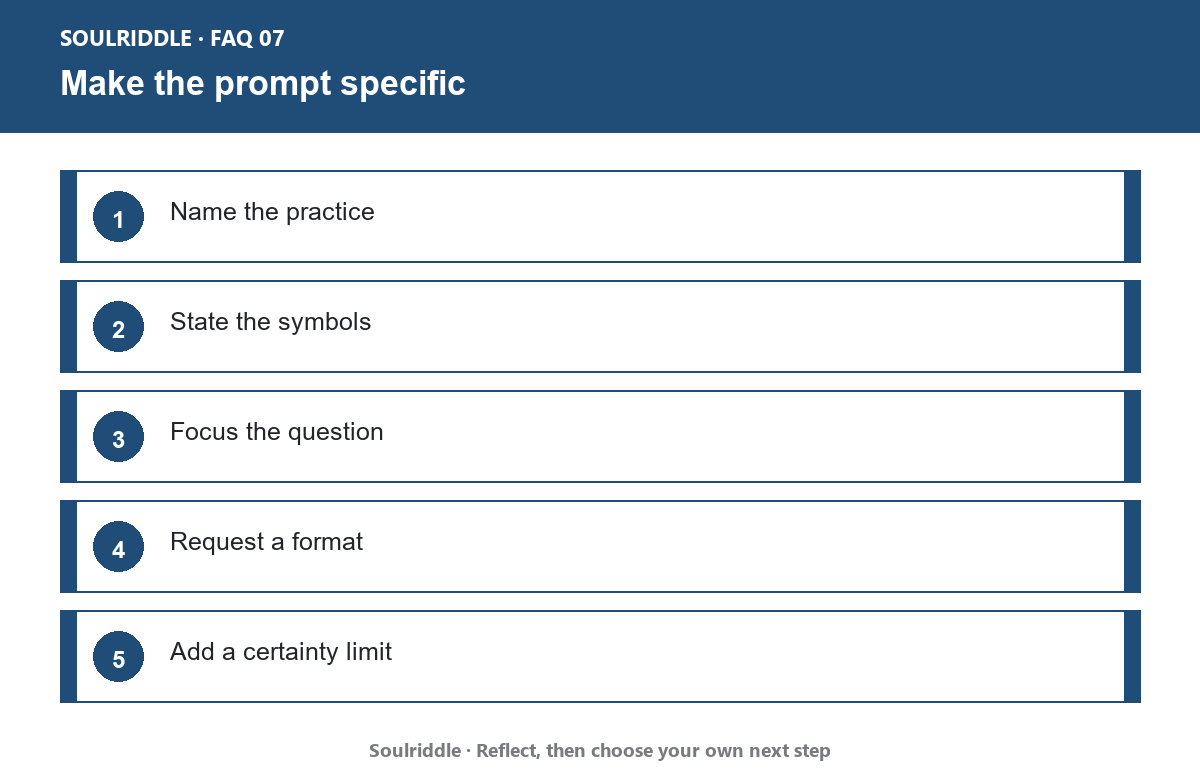
Begin with the practice and the exact symbols you are using. Add a short, neutral description of the situation, then ask one question that can be answered with interpretation and reflection. Request a concrete format: for example, two possible meanings, one caution, and one reflective question. End with a sentence that sets the epistemic boundary, such as asking for conditional language and no definite future claims. After reading the result, tighten any part that produced confusion.
Clarity checklist
What to avoid
Do not use vague pronouns without explaining what they refer to. Avoid stacking several questions in one paragraph. Do not ask the model to choose between contradictory traditions unless you explain the tradition. And do not ask for certainty while also asking for reflection; the two requests pull the answer in opposite directions.
Make the prompt specific
A prompt you can adapt
Using [practice] with [specific symbols], I am reflecting on [situation]. My question is [one focused question]. Please provide two possible interpretations, one important caution, and two reflective questions. Use conditional language and avoid any claim that you can predict the future.
Key takeaway
Key takeaway: Clarity comes from naming the symbol, focusing the question, giving context, specifying format, and setting a limit on certainty.
Source
Source page: Prompt engineering - Wikipedia
Open source page: view the linked page
Open source ↗
Source page screenshot: Prompt engineering - Wikipedia