
Soulriddle FAQ · 17 of 25
How Do You Know Whether a Community AI Prompt Is Worth Trying?
A practical, beginner-friendly answer for using AI and divination as a tool for reflection.
Short answer
A community prompt is worth testing when its purpose is clear, it requests no unnecessary sensitive data, and it explains the kind of output you can expect. Test it with anonymized context first. Check whether the answer is relevant, internally consistent, and appropriately cautious. Avoid prompts that promise certainty, diagnosis, or guaranteed predictions. A prompt does not have to be long or impressive to be useful; it has to produce a result you can evaluate.
Why this matters
Many shared prompts look polished but have not been tested against your situation. Some are designed to produce dramatic or flattering responses rather than useful ones. Evaluating the prompt before trusting the output saves time and reduces the chance of over-sharing. A quick test with neutral, anonymized details is usually enough to see whether the prompt is coherent and safe.
How to approach it
Read the prompt and write down what it asks for, what it promises, and what it returns. Remove or anonymize any personal data, then run a small test case. Evaluate the answer for relevance, internal consistency, and appropriate caution. Run a second test with a slightly different input to see whether the structure holds. If the prompt asks for certainty, diagnosis, or unnecessary sensitive data, either modify it or skip it.
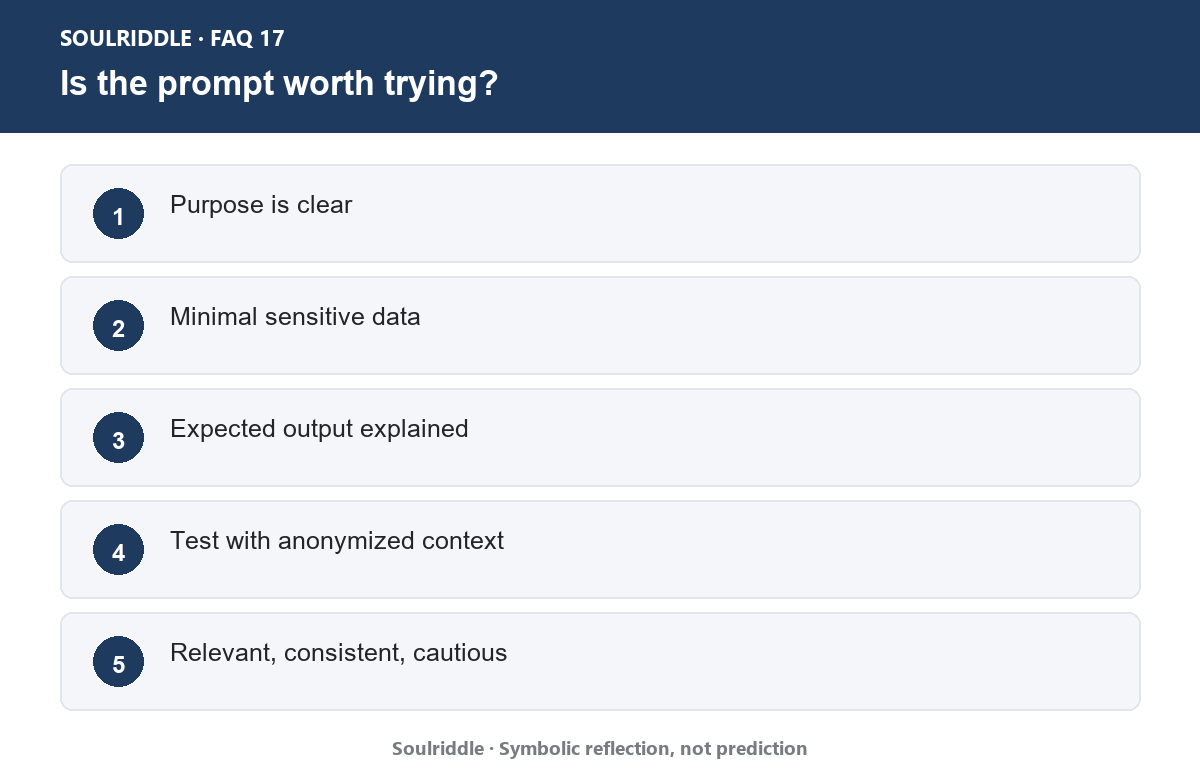
Is the prompt worth trying?
What to avoid
Do not test a prompt with real sensitive information. Avoid prompts that claim to know the future, guarantee results, diagnose conditions, or ask for contact, financial, medical, or identity details. Do not judge a prompt only by how confident the output sounds. If the output changes dramatically with no clear reason, treat the prompt as unreliable.
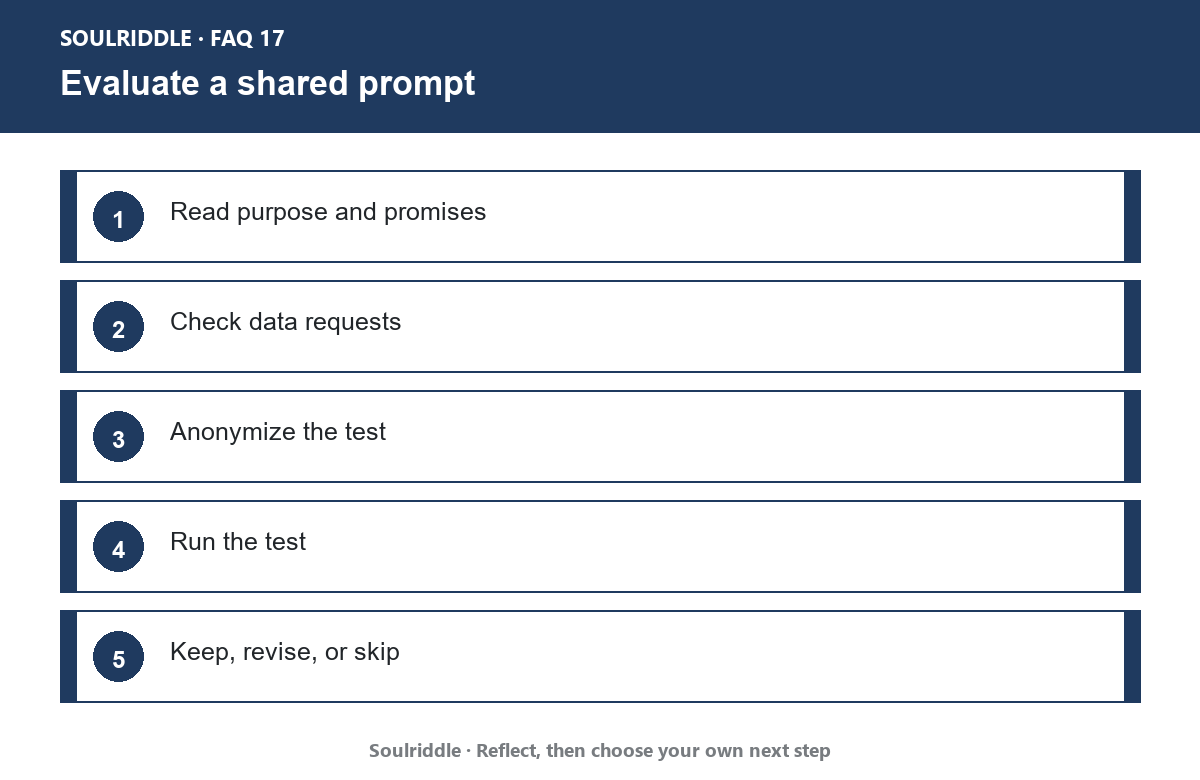
Evaluate a shared prompt
A prompt you can adapt
I am evaluating this prompt for my use: [prompt text]. Please explain its purpose, list the data it requests, and identify any claims of certainty, diagnosis, or guaranteed prediction. Suggest a safer or clearer version if needed.
Key takeaway
Key takeaway: A prompt is worth trying when its purpose is clear, its data requests are minimal, and its output can be tested for relevance, consistency, and caution.
Source
Source page: Braintrust: Prompt Evaluation
Open source page: view the linked page
Open source ↗
Source page screenshot: Braintrust: Prompt Evaluation