Soulriddle FAQ · 25 of 25
How Can You Protect Your Privacy When Sharing Personal Details with AI?
A practical, beginner-friendly answer for using AI and divination as a tool for reflection.
Short answer
Share the minimum context needed and remove names, precise locations, contact details, passwords, government IDs, financial records, health information, and third-party data. Review the provider's privacy controls before sharing sensitive material. In ChatGPT, you can turn off model training for future conversations and use Temporary Chats when appropriate, but settings and defaults can change, so check the current product controls and policies before relying on them.
Why this matters
Divination and reflection prompts often touch on personal relationships, fears, and decisions. Even when a service promises privacy, the safest input is the least identifying input. Minimizing what you share protects not only you but also the people you mention. Privacy is not only about hidden data; it is also about not placing sensitive material in a system whose retention and use you have not fully verified.
How to approach it
Before sending, replace names with roles, use broad regions instead of addresses, and describe the timeframe in general terms. Remove credentials, payment details, medical records, and any third-party identifying information. Check the provider's settings for conversation history, training use, and temporary or private modes. If a request would require sensitive detail, ask the AI how to phrase the same question without it.
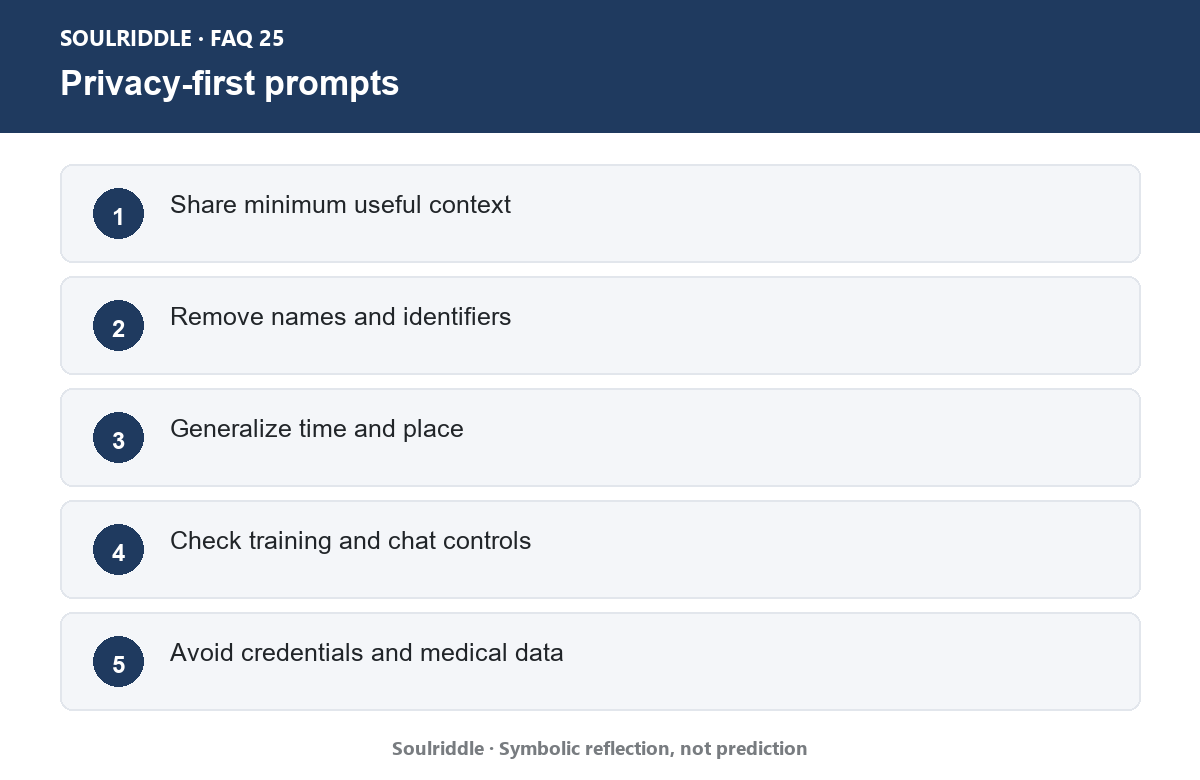
Privacy-first prompts
What to avoid
Do not enter passwords, government IDs, bank or card numbers, precise addresses, contact details, or medical records. Avoid describing another person in identifiable terms without consent. Do not assume that a chat is private just because it feels private. And do not rely on a single setting without reviewing what it actually controls.
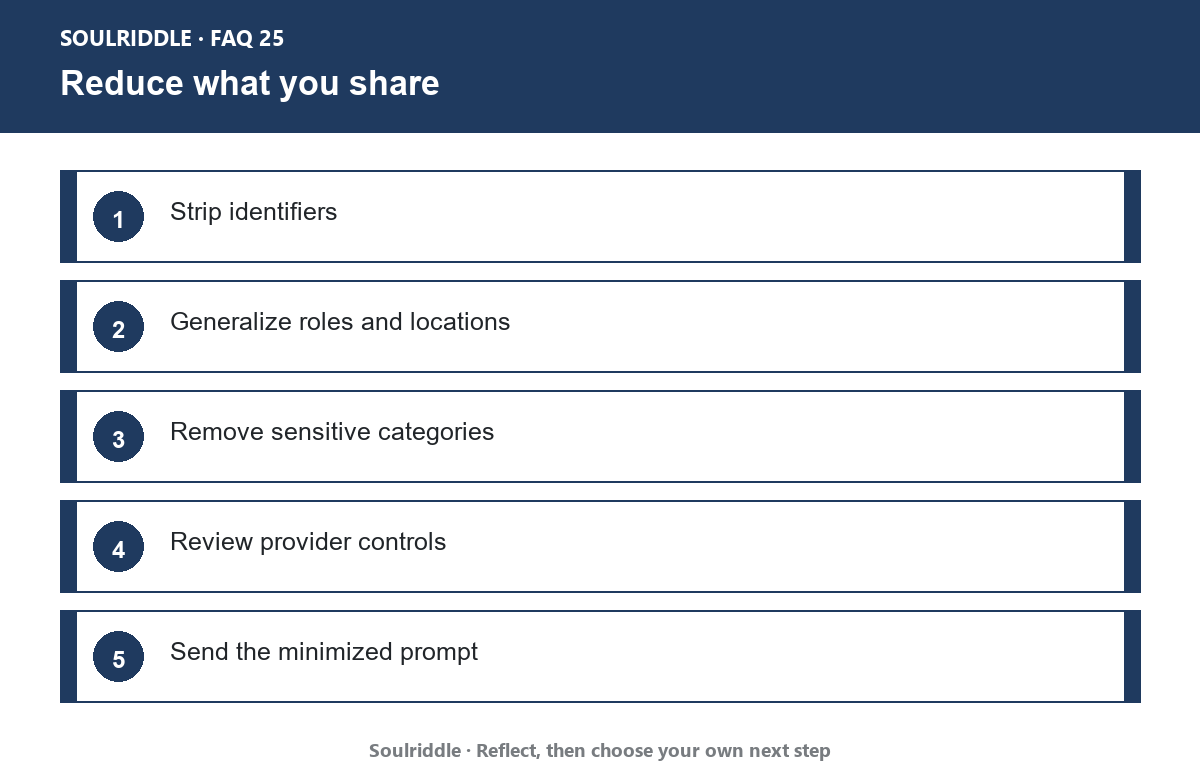
Reduce what you share
A prompt you can adapt
I want to ask about [general situation] without oversharing. Please help me rewrite the question using only the minimum context needed: broad timeframe, general roles, and non-identifying details. Also remind me which categories of personal data I should keep out of the prompt.
Key takeaway
Key takeaway: Protect privacy by minimizing context, removing identifiers, checking provider controls, and asking for the least sensitive way to phrase a question.
Source
Source page: Information privacy - Wikipedia
Open source page: view the linked page
Open source ↗
Source page screenshot: Information privacy - Wikipedia